Kuruli · Pimpri-Chinchwad (PCMC) · industrial belt
Pooja Room Design in Kuruli, Pimpri-Chinchwad (PCMC)
Kuruli is industrial belt within Pimpri-Chinchwad (PCMC), and we are about 30–50 minutes from our Baner studio. Below is what pooja room design actually costs here, what we specify and why, and how long it takes.
Pooja Room Design in Kuruli at a glance
Indicative from
₹60,000
per unit · industrial belt rates
Typical delivery
15–25 days
From design sign-off
Locality profile
industrial belt
Kuruli, Pimpri-Chinchwad (PCMC)
From our studio
30–50 minutes
Same-day site visits
Short answer
Kuruli fits out around a running plant
Kuruli is part of Pimpri-Chinchwad (PCMC) in Pune District, a market defined by new-age township apartments, row houses and fast-growing commercial streets. If you are near Kuruli or Chakan, a designer can usually measure your space on the same visit as the consultation.
That is not background colour, it is the specification. For pooja room design, what gets built in Kuruli is set by how material reaches the site, what the building will allow, and what the weather does to a finish over five years.
A mandir is used with fire and oil every day, so the honest spec question is not how it looks but how it cleans and how the heat is handled.
What we build here
Mostly factory admin blocks, mezzanine offices, canteens and crew welfare rooms, QC and lab cabins.
Getting material to site
Deliveries use the plant loading bay and have to clear gate security, so we schedule them against your shift pattern in Kuruli.
Permissions & work hours
Fire NOC, industrial safety clearance and hot-work permits govern fit-outs here. We close those out before mobilising and put our crew through your site induction.
Structural reality
Mezzanine floors have real load limits, so lightweight partitions, steel-framed joinery and surface conduit beat heavy masonry every time.
Climate load on materials
Joinery in Kuruli has to handle fine agricultural dust, unstable single-phase power and termite pressure from the surrounding soil, with the extra dust load the Pune–Mumbai industrial corridor carries. Cuts haulage cost and plays to what local masons already build well.
Distance from our studio
We are about 30–50 minutes from our Baner studio. We batch PCMC visits so a designer and a site supervisor arrive together and finish measurement in a single trip.
What clients in Kuruli actually ask for
Briefs here repeat, and these are the points that come up before budget does.
- Low-maintenance surfaces, because there is rarely daily help to keep them up.
- Hosting at scale: kitchens and dining that work for twenty people, not four.
- Work phased so the plant never stops, usually across weekends and shift changes.
- Durability costed over five years rather than at purchase.
- Vastu-aware placement agreed with the family before the layout is frozen.
Specification
What we specify for Kuruli
Joinery in Kuruli has to handle fine agricultural dust, unstable single-phase power and termite pressure from the surrounding soil, with the extra dust load the Pune–Mumbai industrial corridor carries. These are the lines that decide whether it survives that, and they are named in the quote rather than summarised as "premium materials".
Local stone and brick where the design allows
Cuts haulage cost and plays to what local masons already build well.
Accessible shut-offs and replaceable cartridges
Borewell water is usually hard, so fittings and geysers scale up faster and need servicing rather than replacing.
Insect-screened openable windows as standard
Open-plot sites need ventilation without the insect load, and retrofitting screens later rarely looks deliberate.
Overhead storage planned around stored water
Supply is intermittent, so utility and bathroom layouts are designed around tanks and pumps from the start.
Matte laminates and textured stone over high gloss
Gloss shows a dust film within hours of cleaning on an open plot.
Pooja Room Design: the trade detail
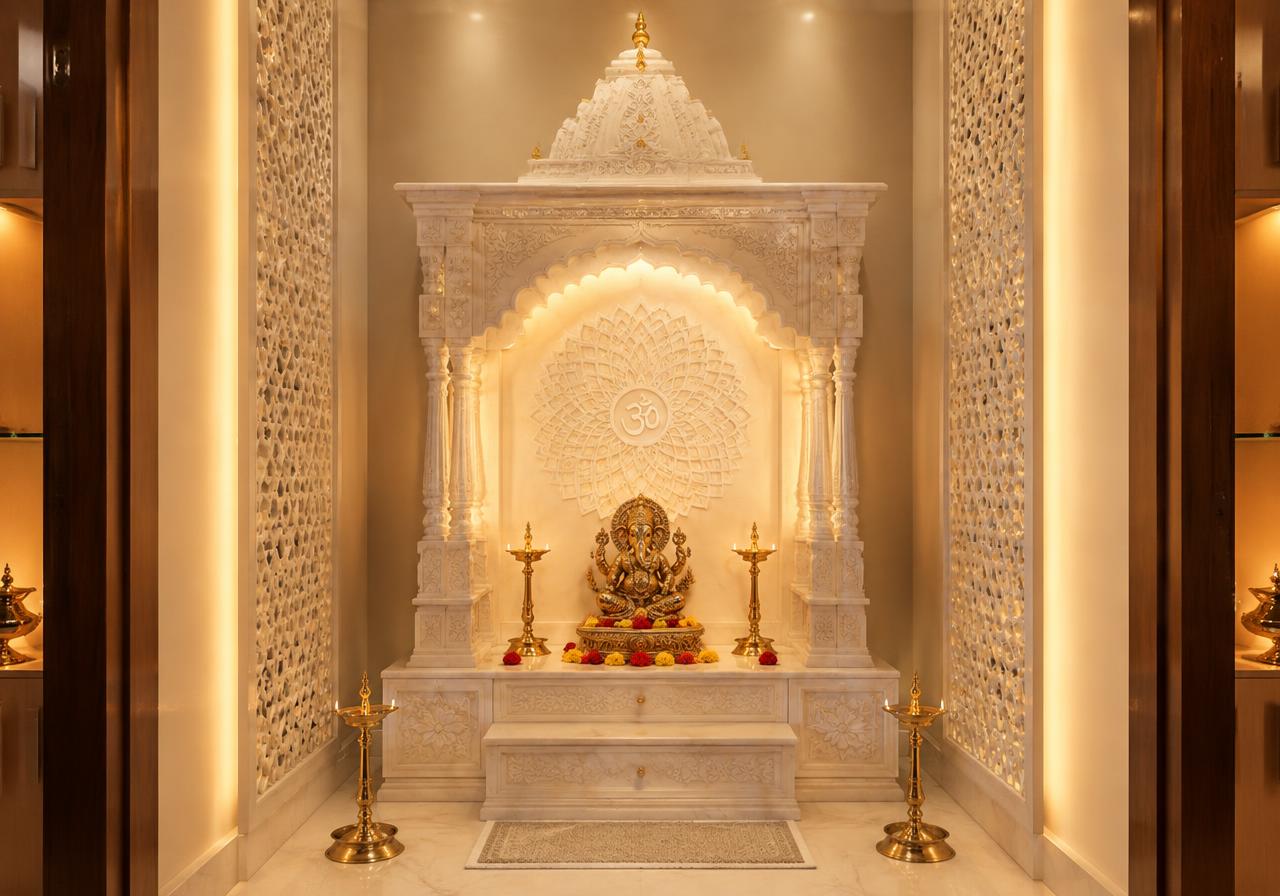
Sealed marble, Corian or jaali-fronted hardwood
Oil lamps and kumkum stain porous stone permanently. Sealed marble and Corian wipe clean; untreated Makrana does not.
Non-combustible lining above the diya position
A plywood soffit directly over a lamp is a genuine fire risk, and it is the detail cheap units skip first.
Backlit onyx or acrylic on a ventilated frame
Heat from a continuously lit lamp behind a sealed panel yellows acrylic within a year. The frame has to breathe.
Jaali in CNC-cut MDF, solid teak or brass
MDF holds the finest CNC detail but cannot take moisture. Solid teak holds up anywhere and costs three to four times as much.
Vastu-aware placement frozen before any wiring or stone cutting
Moving a mandir after the electrical point is run and the marble is cut is the single most expensive change in a home fit-out.
Indicative cost
Pooja Room Design cost in Kuruli
Three specification levels, priced at industrial belt rates for Kuruli. Indicative only — a real number needs a site visit.
| Package | Range (per unit) | Specification |
|---|---|---|
| Essential | ₹60,000 – ₹2.8 L | Laminate or PU-finished carcass, Corian platform, CNC jaali shutters, warm strip lighting, non-combustible soffit |
| Premium | ₹2.8 L – ₹4.3 L | Veneer or PU unit, Indian marble platform and cladding, backlit jaali, brass inlay, separate storage drawers |
| Luxury | ₹4.3 L – ₹5 L+ | Solid-teak carved unit, imported marble or backlit onyx, brass jaali, dedicated 2,700 K accent lighting on a scene control |
Indicative ranges for Kuruli, Pimpri-Chinchwad (PCMC) at industrial belt rates (level with the Pimpri-Chinchwad (PCMC) median). Final pricing follows the site visit and depends on size, finish level and scope. Nothing here is a quotation.
What moves the number in Kuruli
Adds cost here
- Work confined to shift gaps and weekend windows stretches the labour hours needed for identical scope.
- Gate clearance, site induction and hot-work permits add mobilisation days before the first panel arrives.
- The nearest serious hardware market is back in Pune, so material is ordered in larger planned lots with a contingency for a second run out to Kuruli.
Takes cost off here
- Steel-framed partitions and surface conduit are cheaper than masonry and concealed work, and far easier to maintain.
- Plant loading-bay access means full truckloads, so freight per unit is lower than almost anywhere else we work.
- A truck can reverse to the door and there is no society work-hour cap, so crews run full days and labour hours drop.
Delivery plan
15–25 days, phase by phase
Derived from the pooja room design programme and adjusted for what Kuruli allows on site.
Week 1
Survey, layout and 3D sign-off
A designer measures your Kuruli space, we settle the layout against how you actually use it, and the 3D views are signed off before anything is ordered. We batch PCMC visits so a designer and a site supervisor arrive together and finish measurement in a single trip.
Week 1
Material selection and itemised quote
Finishes, board grade, hardware brand and appliances are chosen against physical samples, and the quote names every line separately rather than hiding them under one figure.
Weeks 1–2
Civil, plumbing and electrical first fix
Points shifted, dedicated circuits run and dado work completed. Mezzanine floors have real load limits, so lightweight partitions, steel-framed joinery and surface conduit beat heavy masonry every time.
Week 2
Factory production
Carcasses and shutters are built at our Pune factory to the measurements taken after demolition, not off the builder's drawing. Deliveries use the plant loading bay and have to clear gate security, so we schedule them against your shift pattern in Kuruli.
Week 3
Installation on site
Levelling against out-of-plumb walls, fixing, hardware and alignment. Fire NOC, industrial safety clearance and hot-work permits govern fit-outs here. We close those out before mobilising and put our crew through your site induction.
Week 3
Snag list, clean and handover
A written snag list is closed before the final payment, along with a deep clean, a walkthrough and the hardware warranty documents. Local stone and brick where the design allows is confirmed as installed, not substituted.
Local schedule reality in Kuruli
Styles & scope
What suits Kuruli
Style choices here are made for daylight, humidity and maintenance before they are made for looks.
Farmhouse rustic
Kota, terracotta and sawn teak carry agricultural dust without showing a film the way gloss does an hour after cleaning.
Vernacular Maharashtrian
Verandah, courtyard and jaali planning suits Kuruli's plot sizes and keeps rooms usable without adding air-conditioning tonnage.
Earthy minimal
Matte, textured surfaces read well in the hard open-plot daylight here and clean up with a dry cloth rather than a routine.
Indo-contemporary
Indian materials — Kota, brass, cane, teak — in a contemporary plan. They are locally serviceable and age better here than imported gloss.
What the scope covers in Kuruli
- Marble & Corian mandirs
- Jali partitions
- Vastu-aware placement
- Backlit panels
- Re-measurement after demolition, not off the builder's drawing
- Gate pass, site induction and hot-work permits closed before mobilising
- Mezzanine load checked before any partition is set out
- Work sequenced against your shift pattern, in writing
- A written snag list closed before the final payment
Questions
Pooja Room Design in Kuruli: FAQs
Cost, access, materials and after-sales — answered for Kuruli specifically rather than in general.
How much does pooja room design cost in Kuruli?+
Indicative ranges in Kuruli run from ₹60,000 – ₹2.8 L for an essential specification up to ₹4.3 L – ₹5 L+ at the top end, per unit. Kuruli is industrial belt within Pimpri-Chinchwad (PCMC), so these sit roughly level with the Pimpri-Chinchwad (PCMC) median. After a site visit you get an itemised quote — board grade, hardware brand, finish and labour priced separately — so you can see exactly what moves if the budget moves.
How long does pooja room design take in Kuruli?+
15–25 days from design sign-off for a typical project. Work is phased against your shift pattern and weekend windows so the line never stops. That stretches the calendar without changing the number of working hours. Crews come from the same Pune pool and travel in daily, so no accommodation cost is loaded into your quote.
What permissions and access arrangements do you handle in Kuruli?+
Fire NOC, industrial safety clearance and hot-work permits govern fit-outs here. We close those out before mobilising and put our crew through your site induction. Deliveries use the plant loading bay and have to clear gate security, so we schedule them against your shift pattern in Kuruli.
Which materials actually last in Kuruli?+
Kuruli joinery has to survive fine agricultural dust, unstable single-phase power and termite pressure from the surrounding soil, with the extra dust load the Pune–Mumbai industrial corridor carries. That is why the specification here leads with local stone and brick where the design allows and accessible shut-offs and replaceable cartridges. Cuts haulage cost and plays to what local masons already build well. These are the lines a low quote downgrades quietly, so they are named in writing in ours.
Who handles service visits in Kuruli after handover?+
The same team that built it. We are about 30–50 minutes from our Baner studio. Crews come from the same Pune pool and travel in daily, so no accommodation cost is loaded into your quote. Modular hardware carries the manufacturer's written warranty, and our own workmanship warranty covers the joinery, electrical and plumbing we executed. We batch PCMC visits so a designer and a site supervisor arrive together and finish measurement in a single trip.
What pushes the cost up or down in Kuruli specifically?+
Adding cost: Work confined to shift gaps and weekend windows stretches the labour hours needed for identical scope. Gate clearance, site induction and hot-work permits add mobilisation days before the first panel arrives. Taking it off: Steel-framed partitions and surface conduit are cheaper than masonry and concealed work, and far easier to maintain. Plant loading-bay access means full truckloads, so freight per unit is lower than almost anywhere else we work.
Nearby
Pooja Room Design near Kuruli
Areas next to Kuruli where the building stock and the specification are comparable.
Also in this area
Services that pair with this in Kuruli
Scopes that are usually planned together, so the civil and electrical work happens once.
Free consultation
Planning interiors in Kuruli, Pimpri-Chinchwad (PCMC)?
Share a few details and a senior designer will call you to schedule a site visit, discuss ideas and give you a realistic budget.
Prefer to talk now? +91 96731 98867